Tuesday, January 30, 2024
1:00 p.m. to 2:00 p.m. Eastern
12:00 p.m. to 1:00 p.m. Central
11:00 a.m. to 12:00 p.m. Mountain
10:00 a.m. to 11:00 a.m. Pacific

REGISTER HERE

About the Program

Join Seyfarth’s partners, Michael Wexler, Robert Milligan, and Kate Perrelli for an insightful analysis of the key legal developments in 2023. Gain valuable perspectives that will equip you to navigate the challenges and capitalize on opportunities in this significant area.

In the inaugural session of the 2024 Trade Secrets Webinar Series, our panelists will meticulously examine pivotal legislation, landmark cases, and legal advancements spanning trade secrets and data theft, non-competes and restrictive covenants, and computer fraud on a national scale. Tailored specifically for general counsel, labor and employment counsel, IP counsel, and HR professionals, this webinar offers essential insights into trade secrets, non-competes and restrictive covenants, and computer fraud.

This program will delve into the following key topics:

  • New Legislation Impact and Key Judicial Decisions: Gain practical insights into the impact of new legislation influencing the enforcement of non-competes and restrictive covenants in several jurisdictions, including material changes in California, Minnesota, and potentially New York, and significant judicial decisions impacting enforcement, including in Georgia and Delaware. 
  • Federal Landscape: Stay abreast of legislative and regulatory activity and updates, including the FTC’s proposed rule addressing non-competes with workers, which may significantly impact the enforcement of non-competes nationwide in 2024, and continued NLRB pronouncements. 
  • Trade Secret Misappropriation: Explore significant recent decisions, covering critical aspects such as damages, fees, misappropriation, and pleading standards, including state and Defend Trade Secrets Act decisions. 
  • Computer Fraud Landscape: Understand the current state of computer fraud claims post-recent Supreme Court rulings including significant state computer fraud decisions.

Practical Solutions:

  • Agreements and Policies: Implement best practices for updating and fortifying agreements and policies to protect company assets and trade secrets.
  • Multistate and Remote Work Challenges: Address the unique challenges faced by multistate employers and those managing remote or hybrid workforces.

Exclusive Resource:

  • 50-State Non-Compete/ Trade Secret Desktop Reference: Access our comprehensive overview for an in-depth understanding of non-compete secret laws across the United States. To access, click here.

Speakers

Michael Wexler, Partner, Seyfarth Shaw LLP

Robert Milligan, Partner, Seyfarth Shaw LLP

Kate Perrelli, Partner, Seyfarth Shaw LLP


If you have any questions, please contact Sadie Jay at sjay@seyfarth.com and reference this event.

This program is accredited for CLE in CA, IL, and NY. Credit will be applied as requested but cannot be guaranteed for TX, NJ, GA, NC and WA. The following jurisdictions may accept reciprocal credit with our accredited states, and individuals can use the certificate they receive to gain CLE credit therein: AZ, AR, CT, HI and ME. The following jurisdictions do not require CLE, but attendees will receive general certificates of attendance: DC, MA, MD, MI, SD. For all other jurisdictions, a general certificate of attendance and the necessary materials will be issued that can be used for self-application. Please note that attendance must be submitted within 10 business days of the program taking place. CLE decisions are made by each local board and can take up to 12 weeks to process. If you have questions about jurisdictions, please email CLE@seyfarth.com.

Please note that programming under 50 minutes of CLE content is not eligible for credit in NJ, and programming under 60 minutes of CLE content is not eligible for credit in GA. Programs that are not open to the public are not eligible for credit in NC.

Wednesday, January 10, 2024
12:00 pm – 1:04 pm PT

Seyfarth’s co-chair of the Trade Secrets, Computer Fraud, and Non-Competes practice, Robert Milligan, will lead a panel of legal experts in dissecting the FTC’s recent crackdown on non-compete agreements. This California Lawyers Association webinar, scheduled for January 10, 2024, explores the implications of the FTC’s proposed rule, providing crucial insights for businesses adapting to the changing regulatory landscape.

  • FTC’s recent non-compete crackdown and proposed rule examined by industry experts
  • Impact on trade secrets and insights into FTC’s stance on the matter
  • Policy and practical implications for companies, including guidance on non-disclosure agreements
  • Effective strategies for businesses navigating the evolving regulatory landscape

For more information and to register, click here.

Seyfarth SynopsisEfforts to prohibit non-compete agreements in New York State are back to square one following Governor Hochul’s veto of an outright ban in late December 2023.

As we reported most recently here, New York was set to join a number of states that prohibit non-compete clauses in employment agreements. In June 2023, the Legislature passed a bill that would have declared an outright ban on such agreements, with no exceptions, but its formal “delivery” to the Governor was delayed due to well-publicized concerns that the bill was too draconian, including, among other concerns, that it applied to all workers regardless of income and did not permit non-competes as a term of the sale of a business. 

Continue Reading New York Non-Compete Ban is Off the Table—For Now

In 2023, Seyfarth’s Trade Secrets, Computer Fraud & Non-Compete practice group presented a series of dynamic and insightful CLE webinars, addressing pivotal challenges confronting businesses head-on. The breadth of our discussions encompassed a spectrum of critical topics:

  1. FTC Proposes Rule Banning Use of Non-Competes. Now What?
  2. 2022 Trade Secrets & Non-Competes Year in Review
  3. Commercial Litigation Outlook: Insights and Predictions for Litigation Trends in 2023
  4. NLRB and Restrictive Covenants: Trends in Employment Confidentiality
  5. Managing Trade Secrets in a Remote Work Environment
  6. What Employers Need to Know Regarding Non-Compete Changes in 2023

To conclude our impactful 2023 webinar series, we’ve carefully compiled key takeaways from each session. If you missed any sessions, recordings are available on our blog or through the provided links. We’re excited to share that Continuing Legal Education (CLE) credit is attainable by watching the webinar recordings. For CLE credit inquiries, please email cle@seyfarth.com after viewing the webinar.

Continue Reading 2023 Trade Secrets Webinar Series Recap: Key Takeaways and Access to Recordings

In a recent decision, the Eleventh Circuit seemed to approve a more forgiving standard for reviewing restrictive covenants. Courts generally have three colors in their markup kit for restrictive covenants. The first—and most severe—is the red pencil. In those jurisdictions, if any aspect of a restrictive covenant is overbroad, the court strikes out the whole provision. The second—and most common—is the blue pencil. In blue-pencil jurisdictions, courts may strike out overbroad language but cannot add any language to make the covenant enforceable. The third—and most forgiving—is the purple pencil. These jurisdictions, also called “reformation” jurisdictions, allow a court to insert entirely new language into an overbroad restrictive covenant.

For example, assume that an employee has a non-compete that prevents the employee from providing similar services in Georgia, Florida, and Alabama, but the employee only had responsibilities in Georgia and Miami, Florida. Courts from each of these jurisdictions would likely analyze the non-compete as follows:

Legal FrameworkOutcome
Red PencilThe covenant is not reasonable in its territory, because the employee’s duties did not include the entire territory covered by the non-compete.  The covenant is unenforceable.
Blue Pencil
(strike out only)
The covenant is not reasonable in its territory, because the employee’s duties did not include the entire territory covered by the non-compete. However, the court can strike out Alabama and Florida to make the covenant enforceable. The court would likely refuse to prevent the employee from working in the entire state of Florida if the employee only performed work in part of the state. The revised covenant would prevent the employee from working in Georgia.
Purple Pencil (reformation)The covenant is not reasonable in its territory, because the employee’s duties did not include the entire territory covered by the non-compete. However, the court can strike out Alabama and Florida and add “Miami, Florida” to the non-compete, thus matching the territory where the employee actually worked to the territory covered by the non-compete. The revised covenant would prevent the employee from working in Georgia and Miami, Florida.

But the Eleventh Circuit seemingly introduced a twist to this framework in Baldwin v. Express Oil Change. There, an auto repair franchisor sued an employee that had acquired phantom equity in three companies which operated franchises. The employee signed a non-compete in exchange for roughly $2 million for his phantom equity.

The covenant provided that he would not, for a four-year period, “engage in, invest in, become an owner of, advise, or become a landlord and/or lender of, or employed by, or construct a facility for . . . a Competitive Business” within a defined “Non-Competition Area.” The covenant defined a competitive business as:

an automotive repair or service business . . . which promotes as one or more of its services any form of retail sales of new tires and/or tire-related services, tire rotation, balancing and alignment, oil change services, quick lube services, brake repair or replacements services, transmission repair or service, automotive repairs or similar service.

The covenant defined the “Non-Competition Area” to include all of Georgia and Alabama, as well as “a five (5) mile radius of any automotive repair or service facility business operated by [Franchisor] in the continental United States.”

Following the sale, the employee requested permission to operate a competing auto repair shop within five miles of a store operated by the franchisor. The franchisor refused, so the employee filed a declaratory judgment action in Georgia seeking to invalidate the non-compete.

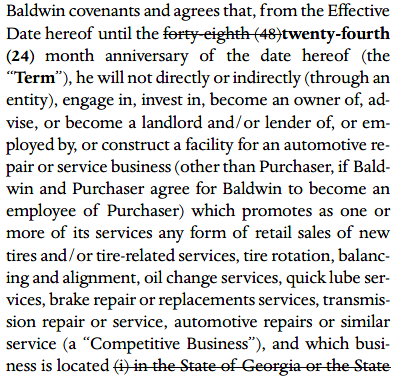
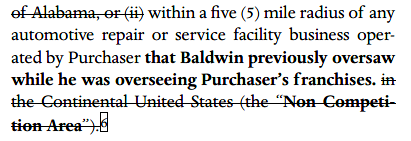
The district court enforced a pared-back version of the non-compete by reducing the temporal duration and the geographic territory of the covenant. Here’s the district court’s markup, with additions in bold and removed language in strikethrough:

The franchisor appealed and argued the district court erred in its revisions to the non-compete. Notably, Baldwin did not cross-appeal the district court’s revisions to the non-compete.

The court of appeals dismissed part of the appeal as moot, vacated the district court’s decision to the extent it reduced the temporal duration of the non-compete, and affirmed the district court’s revisions to the geographic territory.

The last holding is the most important. Here, the district court did more than just strike out language; the district court also added language to create an enforceable territory. The original non-compete covered “a five (5) mile radius of any automotive repair or service facility operation operated by [the franchisor] in the Continental United States.” The district court revised that territory by striking out “the Continental United States” and adding the limitation that the five-mile radius included only locations “that [employee] previously oversaw while he was overseeing [the franchisor’s] franchises.” This revision would generally be classified not as blue-penciling the non-compete, but, rather reforming the non-compete.

The franchisor argued that the district court lacked authority to modify the non-compete as it did by adding new limitations “from whole cloth” when it narrowed the covenant. The court of appeals disagreed, noting that Georgia law authorizes courts to modify overbroad restrictions. However, the court of appeals did not specifically address the nature of the modification: adding language to limit the covenant to a reasonable geographic territory.

Key Takeaways

Although Baldwin dealt with the sale of all or substantially all of a business versus a pure employee/employer covenant, the decision hints that Georgia’s blue pencil might be closer to purple. Prior cases directly held that “[b]lue penciling cannot cure [certain problems], for ‘the “blue pencil” marks, but it does not write. It may limit an area, thus making it reasonable, but it may not rewrite a contract void for vagueness, making it definite by designating a new, clearly demarcated area.” Perhaps covenants that are overbroad but not vague can be re-written to a greater degree than the prevailing viewpoint thought. 

The decision should not, however, be viewed as license to draft extremely broad covenants because a court might save them. Blue-penciling covenants is entirely discretionary, and there is some tension between Baldwin and other decisions from Georgia courts regarding how much leeway courts have in modifying covenants.

If you or your company would like to discuss how this decision might impact your restrictive covenant program, please contact the authors or another member of Seyfarth’s nationally recognized Trade Secrets team.

We invite you to watch our highly anticipated webinar, where Seyfarth Shaw LLP’s leading attorneys in non-compete law skillfully guide you through the intricacies of non-compete agreements in the United States, focusing on the latest updates in 2023. This essential webinar provides exclusive insights from our 2023-2024 edition of the 50-State Desktop Reference.

Here are the key takeaways from the webinar:

  1. Nationwide employers are strongly recommended to review their restrictive covenant agreements. Many states have undergone substantial changes to their laws and substantial liability exists for non-conformance, and federal agencies are increasingly taking the position that overbroad restrictive covenants chill statutorily protected activities.
  2. Minnesota joins California, Oklahoma, and North Dakota as the 4th state to ban employee non-compete agreements.
  3. California recently enacted two new non-compete laws. The first specifies that any contract that is void under California law is unenforceable regardless of where and when the employee signed the contract. The likely impact is that companies may use the new law to attempt to cleanse an out of state employee from an otherwise valid non-compete agreement under another state’s law by having the employee move to California to work. The second requires employers to notify current employees, and for former employees who were employed after January 1, 2022, whose contracts include a noncompete clause, or who were required to enter a noncompete agreement, that does not satisfy an exception to this chapter, by February 14, 2024 that the noncompete clause or noncompete agreement is void. Legal challenge of the two new laws is expected.
  4. Beware of the income threshold increases in several states necessary to enforce restrictive covenant agreements.
  5. Stay tuned for updates on the enforceability of forfeiture-for-competition and claw-back agreements under Delaware law.

To view a recording of the webinar, click here. You can also view all of our Trade Secrets Webinar recordings by clicking here.

On November 30, 2023, Governor Kathy Hochul answered the long-awaited question of whether New York would join California, North Dakota, Oklahoma and, most recently Minnesota, as a state banning the use of non-compete agreements between employers and employees. While New York legislators passed a bill to do just that in June, yesterday, Governor Hochul announced that she would not be signing it.

As we previously addressed, New York’s proposed ban left open a number of questions regarding how broadly the ban would apply, including whether non-solicit clauses would remain viable. In speaking to reporters, Governor Hochul expressed concern regarding another point of overbreadth — that the proposed ban failed to strike the right balance between protecting low and middle-income workers while recognizing that higher-income workers have more negotiating power with employers.  Preliminarily, Governor Hochul suggested a minimum salary of $250,000 as a potential starting point for when employees could be subject to non-competes. 

Based on Governor Hochul’s comments, we may see New York adopt the model of many other states that have instituted minimum income thresholds necessary for employers to be able to enforce non-competes. Given the approximate $2 trillion size of New York’s economy, its actions have outsize influence. We will continue to monitor New York’s next steps.

2023 has brought many changes to the landscape of restrictive covenants—from non-compete bans (actual and proposed), to new court decisions impacting the enforceability of covenants in various jurisdictions, to changes in wage thresholds, and of course we cannot forget California’s new laws that have left many scratching their heads trying to determine how best to comply.

It can be a challenge for employers to keep track of so many changes. In addition to taking a look at our latest 50 state survey (which you can access here), we invite you to join our upcoming webinar this Wednesday, November 29 at 1:00 Eastern/12:00 Central/10:00 Pacific, where we will discuss many of the changes that have occurred or are being contemplated by legislatures, agencies, and key court decisions, and what employers should be aware of as they ring in the new year.

REGISTER HERE

At the State Opening of Parliament last week, the UK Government outlined its legislative agenda through the King’s Speech, an annual address where the ruling monarch, wearing the Imperial State Crown, reads a speech that has been prepared by the current Government outlining the Prime Minister’s priorities for the parliamentary year.

Yesterday’s King’s Speech was notable for several reasons. It was Charles III’s first Speech from the Throne as monarch.  It was the first King’s Speech since the late Queen’s father (and Charles III’s grandfather) George VI addressed Parliament in 1951. It set out a number of domestic and foreign policy priorities for the Government ranging from energy independence and the wars in Israel and Ukraine to regulating football clubs and banning cigarettes forever.

And notably by its absence, it included no reference to the UK Government’s previously-announced proposal to limit non-compete covenants to 3 months after employment.

Currently, non-compete agreements in England and Wales are governed by the common law rule of reason, under which such clauses are enforceable if they a) protect a legitimate business interest of the ex-employer; b) they are no wider than reasonably necessary to protect that legitimate business interest; and c) they are not contrary to the public interest.

Courts in Scotland and Northern Ireland take a similar approach. Although English law currently does not impose any per se limitation on the duration of non-compete covenants, courts throughout the constituent countries of the United Kingdom typically are more willing to enforce non-compete covenants of up to six months after termination of employment than restrictions for longer periods.

As we previously reported, earlier this year, the Government issued a policy paper in which it announced its proposal to limit non-competes. Unlike the approach taken by the U.S. Federal Trade Commission and increasingly taken by U.S. states, the UK Government does not propose banning non-competes outright. Rather, in its policy paper, the Government announced its intention to introduce legislation that will limit the length of non-compete clauses to 3 months. The Government’s policy paper indicates that the Government’s proposed legislation “will not interfere with the ability of employers to use (paid) notice periods or gardening leave, or to use non-solicitation clauses. These reforms will not cut across arrangements on confidentiality clauses, nor will they affect restrictions on (former) public sector employees under the business appointment rules.”

Although the Government’s policy paper last May announced the Government’s intention to “legislate when parliamentary time allows,” to date no bill has been introduced on this topic. The absence of any reference to this proposal in the King’s Speech suggests that limiting non-competes likely is not a major priority of the Government and that a bill to limit non-competes may not be introduced in the House of Commons any time soon, despite the fact that a limitation on non-competes likely would garner support from the Opposition benches.

That said, if the last decade has shown anything, it has shown that political developments on both sides of the Atlantic are often unpredictable. Given the current trend to restrict non-compete covenants on both sides of the Atlantic, companies with employees in either the United Kingdom or the United States should take a close look at their existing agreements to ensure that they are compliant with current law and that they are sufficiently flexible to address changes in the law in the months ahead.

Boston Beer Corporation (“Boston Beer”) recently filed suit seeking monetary and injunctive relief in Massachusetts state court, alleging a former employee and his new employer, the competing alcoholic beverage company Downeast Cider House LLC (“Downeast”), were using Boston Beer’s trade secrets to unfairly compete with it and divert business opportunities to Downeast.

Boston Beer is a brewer and marketer of beers, malt beverages, and hard ciders, known for its Samuel Adams and Angry Orchard products. Downeast is a rival maker and marketer of similar products, namely its eponymous cider.

In 2015, Boston Beer hired an employee, who was eventually promoted to a manager of IT, sales, and business analysis. As part of his employment, the manager entered an Employment Agreement with Boston Beer. The Employment Agreement contained post-employment covenants, including a non-disclosure clause by which the manager agreed not to use or disclose any Boston Beer confidential information during or after his employment. The manager also agreed to a non-compete clause that prohibited him from importing, producing, marketing, or distributing malt beverages, hard cider, or other competing products for a period of one year after the date of his last compensation from Boston Beer. Another provision of the agreement provides that the manager must repay Boston Beer for training days provided during his employment.

Boston Beer alleges that the manager’s role involved learning unique sales and marketing methodologies developed by Boston Beer as well as sales strategies, investment information, marketing intel, and development knowledge, all of which the company considers confidential information protected by the Employment Agreement. Purportedly, through strategy meetings and throughout his tenure, the manager was privy to the company’s strategies for competing with market competitors like Downeast.

In April 2023, the manager voluntarily resigned from Boston Beer. Shortly thereafter, he became a Senior Vice President of Marketing at Downeast. Boston Beer alleges that, in this role, the former manager will inevitably utilize the confidential information he learned through his role at Boston Beer. The company contends that Downeast solicited and hired the former manager for the specific purpose of competing with Boston Beer using the advantage of the confidential insights he gained from his role there.

After the manager’s resignation, Boston Beer alleges it conducted a forensic examination of his company computer which revealed the manager had connected an external device to access and potentially download confidential information in the days before his voluntary departure. The accessed files include market plans, sales performance measures, pricing guides, budgets, and brand documents. Boston Beer contends this access signals the former manager’s intent to wrongfully use the documents and other information to compete with Boston Beer at Downeast.

In October 2023, Boston Beer filed suit in the Superior Court of Suffolk County, alleging breach of the non-compete clause, non-disclosure clause, and training repayment clause; intentional interference with contract; misappropriation of trade secrets; breach of fiduciary duty; and unjust enrichment. Boston Beer sought a preliminary injunction to prevent the former manager from continuing his work for Downeast for a one-year period following his last payment from Boston Beer or disclosing to Downeast (or anyone else) any confidential information of Boston Beer. Similarly, the injunction request also seeks to enjoin Downeast from accepting his work or Boston Beer confidential information. But notably, Boston Beer has yet to file a motion for injunctive relief, more than 3 weeks after the complaint was filed. The Court has thus not yet ruled on the injunction request in the complaint, as there is no pending motion for such relief, but especially for Boston beverage fans, this dispute may prove to be, well, intoxicating.