This post was originally published on Seyfarth’s Gadgets, Gigabytes & Goodwill blog.

Ransomware attacks have become one of the most common and pervasive cybercrimes perpetrated against US companies. A bad actor, often from overseas, will gain access to upload malware onto a company’s network storage or application platforms that encrypts all files it can access. A message or text file is usually left with instructions on how to contact the attacker to pay a ransom for the decryption key. In the worst case, a ransomware attack can freeze the business operations by effectively removing access to the company’s critical systems and rendering them useless. Aside from the business impact, what legal implications are created by a ransomware attack?

Continue Reading Ransomware Attacks: Harmless Annoyances or Catastrophic Events?

dawn mertineit named vice chair

Seyfarth partner Dawn Mertineit was recently named Vice Chair of the Trade Secrets Committee for the Intellectual Property Owners Association (IPO).

The Trade Secrets Committee focuses on providing practical education to IPO membership and the public on the topic of trade secrets, including presentations, white papers, and form documents. Find more information about the IPO Trade Secret Committee on the IPO website.

On January 4, 2023, the Dallas Court of Appeals in Texas affirmed a summary judgment in a trade secrets physician staffing case that stands as a warning to practitioners regarding (1) what constitutes sufficient damages evidence to survive summary judgment, and (2) whether something can be considered on appeal that has been sealed or subject to a confidentiality agreement.

Continue Reading Texas Court of Appeals Affirms Summary Judgment in Physician Staffing Case Citing Lack of Damages Evidence

On Thursday, January 19 at 10 a.m. Eastern, Boston partner Dawn Mertineit is presenting a webinar for the Federal Bar Association and myLawCLE. The “Drafting and Enforcing Restrictive Covenants in Multiple Jurisdictions” webinar covers best practices and key tips for businesses with employees in multiple jurisdictions, from drafting restrictive covenants agreements, implementing a plan to roll those agreements out, and enforcing those agreements should an employee breach them.

Key topics include:

  • Whether to use a single agreement for various jurisdictions, or multiple different agreements
  • Which states have choice of law or forum provisions to be aware of
  • Which states impose strict penalties for failure to comply with restrictive covenants statutes
  • Legislative and regulatory update, including the FTC’s recent proposed rule that would ban almost all non-competes

For more information and to register, visit the Federal Bar Association website or the myLawCLE website.

In the first installment of our 2023 Trade Secrets & Non-Competes Webinar Series, Seyfarth partners Kate Perrelli, Michael Wexler, Robert Milligan, Dan Hart, and Dawn Mertineit discussed the new Federal Trade Commission’s (“FTC”) proposed rule banning the use of non-competes with employees and workers. The expert panel addressed what the proposed rule would do and what employers need to know to respond.

As a conclusion to this webinar, we compiled a summary of takeaways:

  • The FTC’s attempted regulation of employment non-competes as part of its rulemaking powers is unprecedent in the 109 years since its creation in 1914. The FTC bases its rulemaking authority on Section 5 of the Federal Trade Commission Act, which provides: “The Commission is hereby empowered and directed to prevent persons, partnerships, or corporations . .. from using unfair methods of competition in or affecting commerce and unfair or deceptive acts or practices in or affecting commerce.” 15 USC § 45(2).
  • On November 10, 2022, the majority on the FTC issued a new policy statement that outlined an expansive definition of “unfair methods of competition” and indicated that it would engage in aggressive enforcement of actions that it regards as “unfair methods of competition,” even if those actions do not constitute violations of federal antitrust law.  The proposed Rule is the FTC’s first test of the broader powers that it claimed in its November statement, and the proposed Rule is much broader than anything that the Biden Administration had previously hinted at, including in then-candidate Biden’s platform campaign statement or in the 2021 executive order. A day before the FTC issued its proposed rulemaking, FTC that issued a press release that it had sued, and reach a settlement with, three employers in the security and manufacturing sector that the FTC alleged had “illegally imposed noncompete restrictions on workers.” Thus, the FTC apparently is not waiting for a final rule before flexing its muscle and employers should examine their existing non-competes to determine whether they are overly broad and may invite FTC scrutiny.
  • The proposed rule impacts not just typical employee non-compete agreements but also non-compete agreements that are made in connection with the sale of business entities. While there is an exception for a substantial owner of, or substantial member or substantial partner in, the business entity at the time the person enters into the non-compete clause defined as an owner, member, or partner holding at least a 25 percent ownership interest in a business entity, the 25% interest threshold is arbitrary and ignores the business realities, complexity and individuality of such transactions. Moreover, it applies retroactively to such transactions so parties to the transaction may not get the benefit of their bargain.
  • The proposed rule is only a proposal at this point, as the FTC has solicited public comment on the proposed rule before it issues a final rule.  The deadline to submit comments is March 20, 2023, and we encourage all affected employers to submit comments.
  • It’s unclear whether the final rule will be as sweeping as the current proposal.  Regardless of the final form of the rule, we expect legal challenges to the FTC’s rulemaking, including significant constitutional challenges to whether the FTC has power to issue rules at all on worker non-competes.
  • In the interim, employers should take a close look at their restrictive covenant agreements to ensure that they are reasonable and compliant with ever-evolving state law.

You can view a recording of the webinar and all other webinars in our Trade Secrets & Non-Competes Webinar Series here.

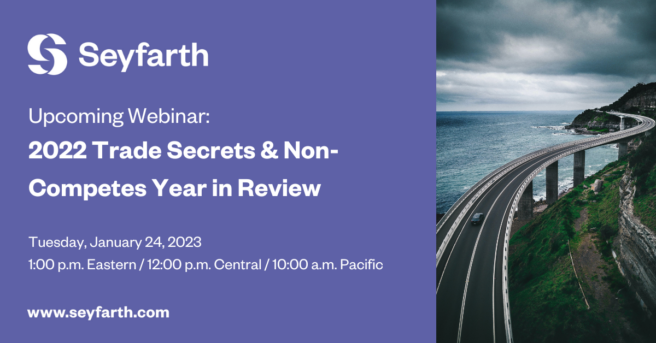
Trade Secrets Year in Review Webinar

Tuesday, January 24, 2023
1:00 p.m. to 2:00 p.m. Eastern
12:00 p.m. to 1:00 p.m. Central
11:00 a.m. to 12:00 p.m. Mountain
10:00 a.m. to 11:00 a.m. Pacific

REGISTER HERE

In the second installment of the 2023 Trade Secrets Webinar Series, Seyfarth attorneys will review the noteworthy legislation, cases, and legal developments from across the nation over the last year in the areas of trade secrets and data theft, non-competes and other restrictive covenants, and computer fraud. Plus, they will provide predictions for what to expect in 2023.

Seyfarth attorneys, Michael Wexler, Robert Milligan, and Joshua Salinas will address the following topics: 

  • Significant new legislation for non-competes and other restrictive covenants and related court decisions that may affect their enforcement
  • Discussion of legislative and regulatory efforts to narrow use on non-competes and restrictive covenants at the federal level, specifically the new FTC proposed rule banning the use of non-competes with workers.
  • The Defend Trade Secrets Act and tips for navigating the law
  • Recent significant trade secret misappropriation decisions concerning damages, fees, and pleading
  • The viability of computer fraud claims in light of recent Supreme Court decisions
  • Best practices for updating and structuring agreements and policies to adequately protect company assets and trade secrets, including addressing the challenges for multistate employers and the challenges for a remote or hybrid workforce

In addition to this webinar, we invite you to download a copy of the most recent edition of our 50 State Non-Compete Desktop Reference.

Speakers
Michael Wexler, Partner, Seyfarth Shaw LLP
Robert Milligan, Partner, Seyfarth Shaw LLP
Joshua Salinas, Associate, Seyfarth Shaw LLP

REGISTER HERE


If you have any questions, please contact Colleen Vest at cvest@seyfarth.com and reference this event. 

This webinar is accredited for CLE in CA, IL, NJ, and NY. Credit will be applied for as requested for TX, GA, WA, NC and VA. The following jurisdictions may accept reciprocal credit with these accredited states, and individuals can use the certificate they receive to gain CLE credit therein: AZ, CT, NH. The following jurisdictions do not require CLE, but attendees will receive general certificates of attendance: DC, MA, MD, MI, SD. For all other jurisdictions, a general certificate of attendance and the necessary materials will be issued that can be used in other jurisdictions for self-application. Please note that attendance must be submitted within 10 business days of the program taking place. If you have questions about jurisdictions, please email CLE@seyfarth.com. CLE credit for this recording expires on January 23, 2024.

As our colleagues have previously reported in this blog, on January 5, 2023, the Federal Trade Commission issued a notice of proposed rulemaking (NPRM) concerning its unprecedented effort to ban all non-compete clauses with workers and to preempt state law on the issue. The NPRM followed just one day after the FTC announced that it had reached a consent settlement with three companies for alleged unfair trade practices by imposing overly burdensome non-compete agreements.

Not surprisingly, the NPRM has sparked a surge of commentary in the legal and business communities and immediately courted controversy. The sole Republican member of the FTC, Commissioner Christine S. Wilson, issued a vigorous dissent, arguing:

Continue Reading Answering the $296 Billion Question: FTC’s Proposed Rulemaking on Worker Non-Competes Likely to be Found Unconstitutional

Thursday, January 12, 2023
3:00 p.m. to 4:00 p.m. Eastern 
2:00 p.m. to 3:00 p.m. Central
1:00 p.m. to 2:00 p.m. Mountain
12:00 p.m. to 1:00 p.m. Pacific

REGISTER HERE

In the first installment of the 2023 Trade Secrets & Non-Competes Webinar Series, our team will focus on the new Federal Trade Commission’s (“FTC”) proposed rule banning the use of non-competes with employees and workers. If adopted, the proposed rule will bar both prospective and existing non-compete agreements. The proposed rule comes after allegations that some employers were abusing non-compete agreements by deploying such agreements in ways that go well beyond preventing unfair competition or protecting trade secrets. The expert panel will address what the proposed rule would do and what employers need to know to respond.

Seyfarth partners Michael Wexler, Robert Milligan, Kate Perrelli, Dan Hart, and Dawn Mertineit will address the following topics:

  • An overview of how we got here
  • The FTC’s proposed rule banning non-competes and the FTC’s reasoning and justification for the proposed rule
  • The dissent and business community’s response to the proposed rule, including discussion of problems with the proposed rule
  • Alternative approaches
  • What happens next and practical tips for what companies should do now in terms of restrictive covenant agreements

Speakers
Michael Wexler, Partner, Seyfarth Shaw LLP
Robert Milligan, Partner, Seyfarth Shaw LLP
Kate Perrelli, Partner, Seyfarth Shaw LLP
Dan Hart, Partner, Seyfarth Shaw LLP
Dawn Mertineit, Partner, Seyfarth Shaw LLP

REGISTER HERE


If you have any questions, please contact Colleen Vest at cvest@seyfarth.com and reference this event. 

This webinar is accredited for CLE in CA, IL, NJ, and NY. Credit will be applied for as requested for TX, GA, WA, NC and VA. The following jurisdictions may accept reciprocal credit with these accredited states, and individuals can use the certificate they receive to gain CLE credit therein: AZ, CT, NH. The following jurisdictions do not require CLE, but attendees will receive general certificates of attendance: DC, MA, MD, MI, SD. For all other jurisdictions, a general certificate of attendance and the necessary materials will be issued that can be used in other jurisdictions for self-application. Please note that attendance must be submitted within 10 business days of the program taking place. If you have questions about jurisdictions, please email CLE@seyfarth.com. CLE credit for this recording expires on January 11, 2024.

Earlier today, the Federal Trade Commission (“FTC”) published a proposed rule which would ban all non-compete agreements between employers and “workers” (broadly defined to include employees, independent contractors, interns, and others). If adopted, the proposed rule will bar both prospective and existing non-compete agreements. The FTC included an overview fact sheet describing the proposed rule.

The FTC is seeking public comment on the proposed rule, which is based on a preliminary finding that non-competes constitute an unfair method of competition and therefore violate Section 5 of the Federal Trade Commission Act. This proposed rule aligns with the FTC’s recent statement to attempt to reinvigorate Section 5 of the FTC Act, which bans unfair methods of competition.

Continue Reading FTC Proposes Rule Banning Use of Non-Competes with Employees and Workers and Limiting Employer Protections Against Unfair Competition

Earlier this year, Seyfarth Shaw partnered to issue the 2022 Future Employer survey to clients and contacts. We surveyed in-house legal and business leaders to find out how they are thinking about the “Future of Work.” This was an important continuation of Seyfarth’s thought leadership endeavors related to futurist legal-thinking and the future of work, which we formalized five years ago with the inaugural survey in 2017. With respect to the protection of company data and intellectual property, the survey results highlight the need for companies to have thoughtful policies and procedures that address data usage and retention in a hybrid work environment.

Continue Reading Future Employer Survey Results Highlight Need For Companies To Implement Thoughtful Policies To Protect Company Data and Intellectual Property in Hybrid Work Environment